What Is A Stimpmeter?
A stimpmeter is the tool greenkeepers use to measure how fast a putting green is. It’s a simple metal ramp, and the number it produces tells you exactly what kind of green you’re about to putt on.
How A Stimpmeter Works
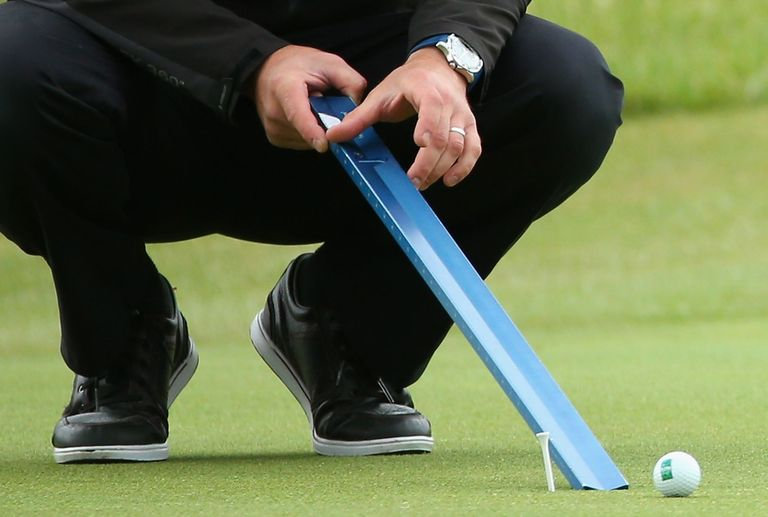
The device itself is a grooved aluminium ramp, about three feet long, with a notch near the top. A ball is released from that notch and rolls down the ramp onto the green under its own weight, not a push. Whoever’s testing measures how far the ball rolls once it’s on the flat surface, in feet.
To get a fair reading, the test is run three times in one direction and three times in the opposite direction, on a flat section of green. The six distances are averaged. That average is the stimpmeter reading — usually written as a single number, like “10.5.”
What The Stimpmeter Number Means
The higher the number, the faster the green. An average club green usually stimps somewhere between 8 and 9. Major tournament greens, especially at somewhere like Augusta National, can run as fast as 13 or 14.
That gap matters more than it sounds. A putt that needs a firm, confident stroke on a slow green will run three or four feet past the hole on a fast one. The stimpmeter number is really just a shorthand for “how hard should I actually hit this.”
Where The Term Comes From
The stimpmeter is named after Edward Stimpson, a Massachusetts amateur golfer who built the original device in the 1930s. He came up with the idea after watching a US Open where the greens were so inconsistent that some competitors faced conditions completely different from others in the same event. His invention gave course staff a way to measure and compare green speed properly, rather than guessing.
Why Green Speed Isn’t Fixed
A stimpmeter reading isn’t a permanent fact about a golf course — it changes constantly. Mowing height, moisture, temperature, and even the time of day all affect how a green rolls. A course that stimps at 10 in the morning dew might be closer to 11 by mid-afternoon once things dry out.
That’s worth remembering if you hear a course boasting about its stimpmeter number. The reading you’re told about is a snapshot, not a guarantee of what you’ll actually face when you play.
Why It Matters To Your Game
You don’t need your own stimpmeter to use this information. What matters is recognising fast greens versus slow ones in the first few holes, then adjusting how firmly you hit every putt after that. Most amateur three-putts come from misjudging pace on a green that’s faster or slower than expected, not from reading the line wrong.
If you’re playing a new course, treat your first two or three putts as information gathering. Hit them the way you normally would, watch how far they run, and recalibrate before it costs you a hole.
Stimpmeter FAQs
What’s a normal stimpmeter reading for a golf club? Most everyday club greens stimp somewhere between 8 and 9.5. Anything faster usually means the green staff have prepared the course for a competition.
What do tournament greens usually stimp at? Professional tournaments typically run greens between 11 and 13, with somewhere like Augusta National occasionally pushing past 13.
Can you measure green speed without an official stimpmeter? Not accurately. The device relies on a consistent ramp angle and release height, so a homemade version won’t give a reliable reading. You can still get a feel for pace by watching how far your first few putts run.
Does a faster stimpmeter reading mean a harder green to putt on? Not necessarily harder, just different. Fast greens punish a heavy-handed stroke, while slow greens punish a stroke that’s too soft. Both take adjustment.